

By Maliha Rehman
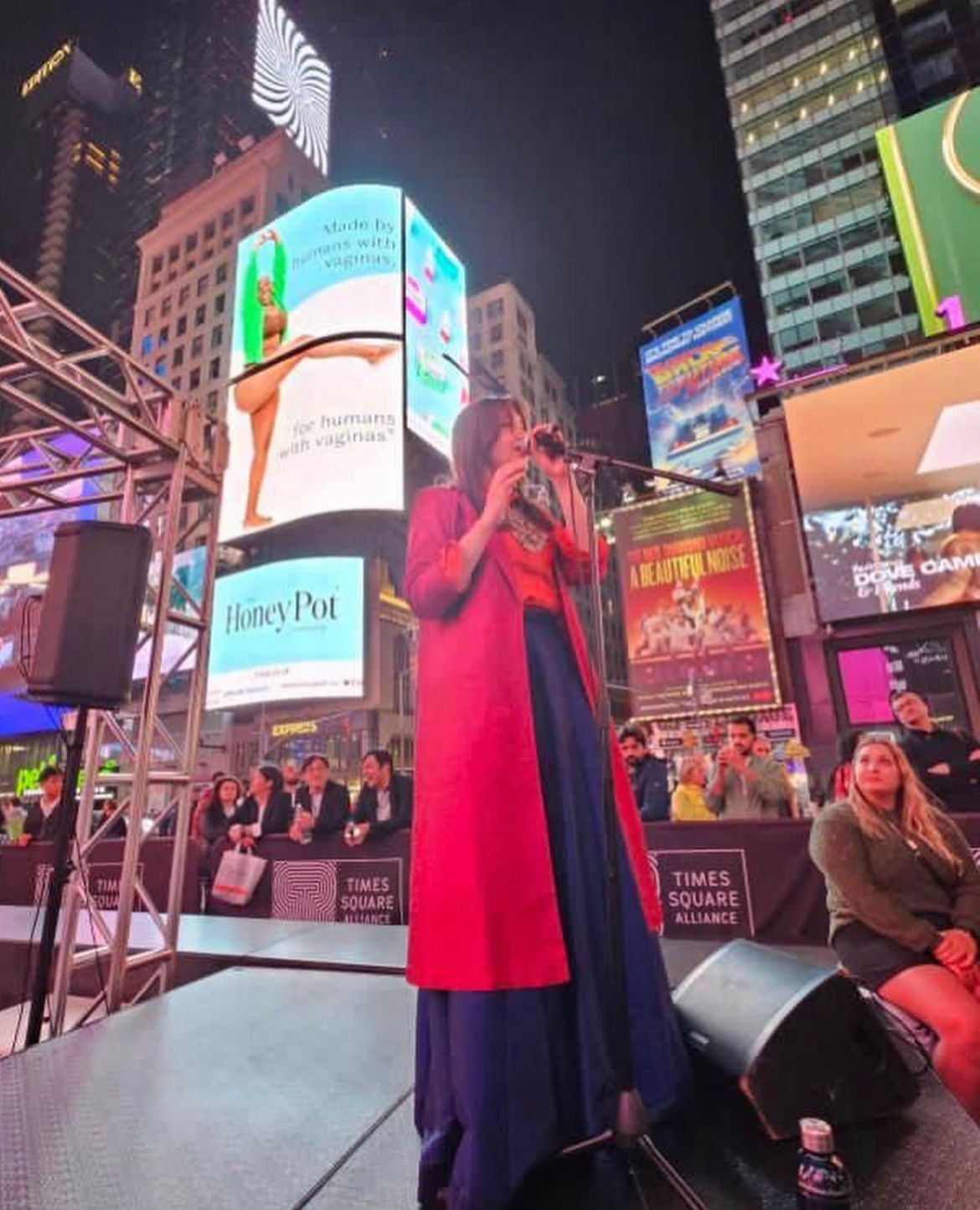
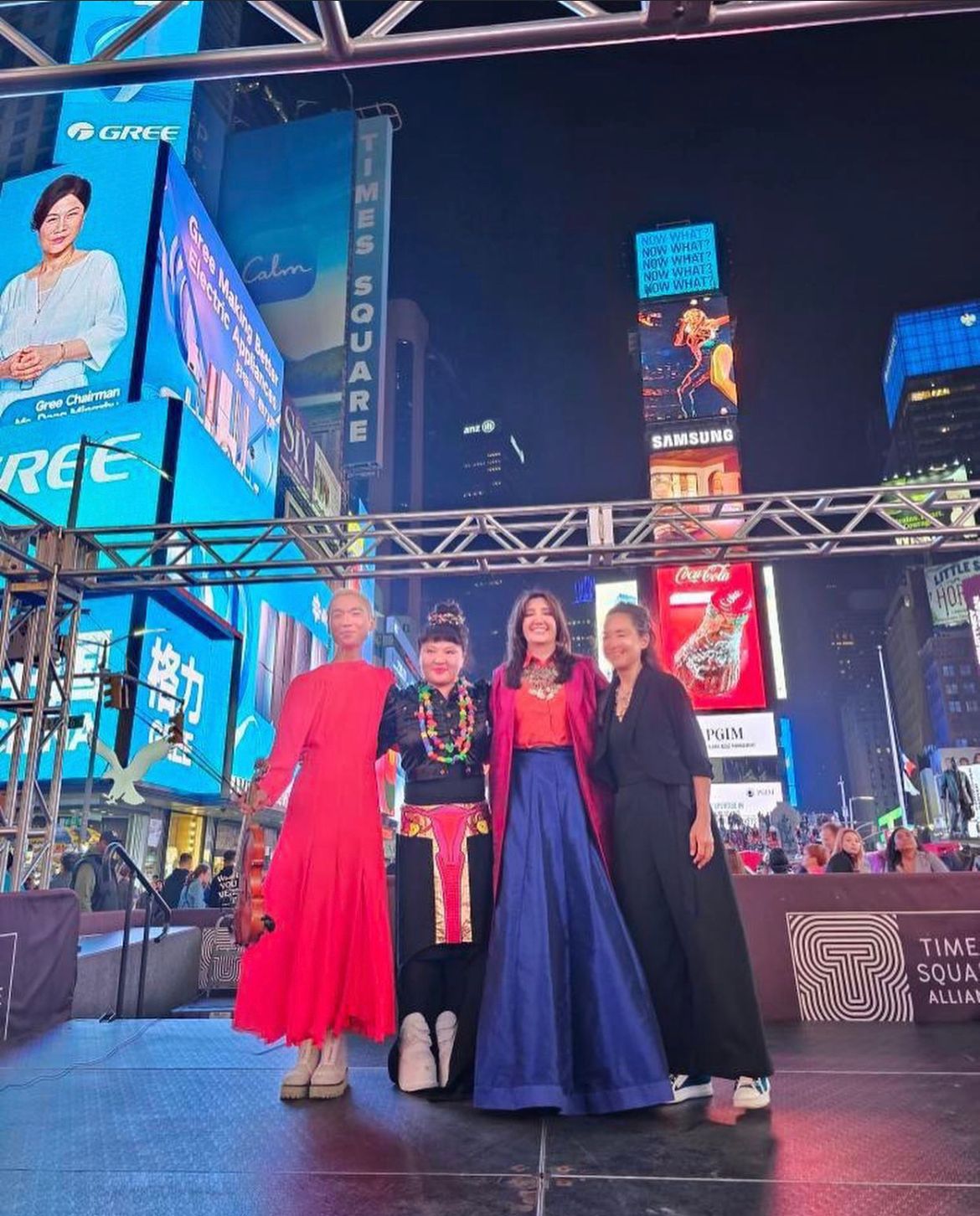
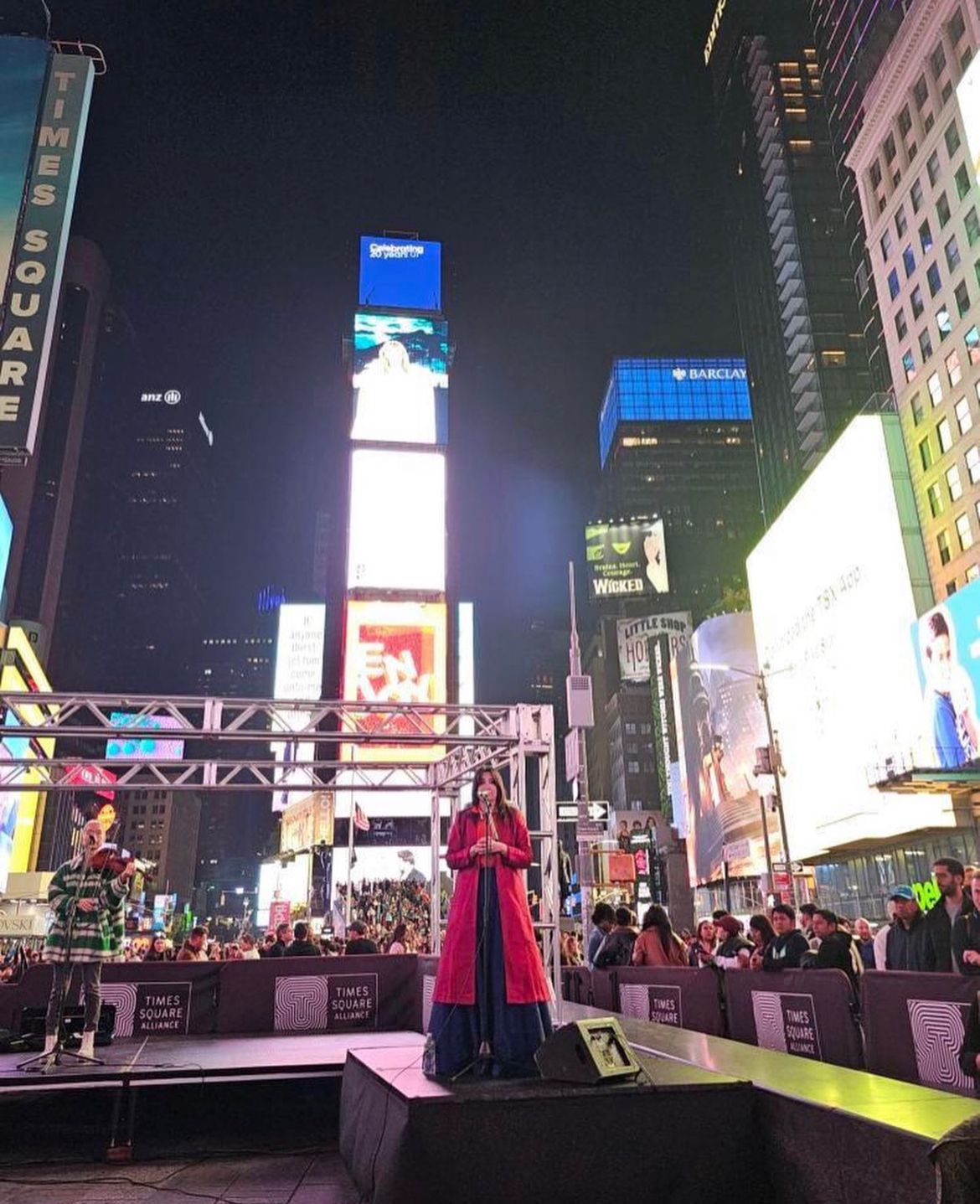
Some weeks ago, Zeb Bangash became the first Pakistani woman to sing at the Times Square in New York. Standing center stage, the artist performed in a collaboration with artist Shahzia Sikandar, Pulitzer prize-winning composer Du Yin and artist Eddy Kwon. It was a proud moment for her – and veritably, for Pakistan.
The collaboration is one which has already been witnessed at the Lahore Biennale and now, it was spotlighted at one of the world’s most iconic locations. Accompanying visuals of ‘The Reckoning’, Shahzia’s Indo-Persian-Turkish painting that depicts themes of conflict and connection in abstract, was the spoken word and music, in a live rendition that lasted for about half an hour.
Taking to the stage, Zeb wore raw silk in a medley of colors. A burnt orange button-down shirt tucked into a navy skirt was paired by a long coat in fuchsia. A large statement Afghan neck-piece – possibly a headpiece at some point in time – complemented the look. She looked bright and colorful and beautiful but more than her sartorial statements, the crowds gathered at the iconic location were there to hear her sing.
Following the ceremony, Zeb spoke to me, describing her experience: “I’ve always been overwhelmed by Times Square but that night, I felt like I was a part of it. “’The Reckoning’ has been honored at the Times Square for seven minutes every day this September and the organizers decided that a live performance would be a powerful way of culminating the tribute. I felt honored to be part of a collaboration like this and moreover, to be part of Shahzia’s success story. Du Yin wanted me to sing something intimate which was a bit risky especially after Eddy Kwon’s electrifying piece but it just flowed naturally and we were all in sync.”
For the prelude, she sang an improv alaap which went into the Maand Padharo Mhare Des melody. Then, when Shahzia Sikandar’s ‘Reckoning’ began to unveil, Zeb sang a couplet from a Black Sea tune Ben Seni Sevdugumi, adding improv alaaps in the scale.
View this post on Instagram
“The crowd was there with me the whole time,” she says, “they responded to every bit, even the softest runs. It felt magical to be embraced by the Square as it got adorned by Shahzia’s masterpiece. It was like a dream come true.”
There are many more dreams that have come true for Zeb this year. The artist has always been distinctive, paving her own musical journey rather than band-wagoning on to popular themes and tastes. This dedication has ensured that her work stands out over the past two decades, won her critical and commercial acclaim and allowed her to pursue paths that are meaningful.
One such path has led to the formation of the Khayal Residency this year, aimed towards nurturing traditional music. Six individuals are taken on board in a four months long immersive residency program and undergo vocal training under the tutelage of Ustad Naseeruddin Saami and his sons Rauf Saami and Urooj Saami. “I feel so passionately about the Residency,” said Zeb, talking to me a few days before she flew off to New York. “It’s extremely important to be aware of and take pride in all that the Muslim arts have given to the world. We have a strong creative output as far as Western pop music is concerned here in Pakistan. But I often wonder what the creative output of each generation would be if they were given the exposure and chance to understand and train in our traditional music and poetry. Khayal is a highly intricate system of ancient Sufi music based on 49 microtones of which Ustad Naseeruddin Saami is the only living maestro. I am supremely lucky that he is also my teacher. His knowledge and craft has been passed on to him from the Delhi gharana that he hails from. Even within his family he is unique because he is the only one in his generation who chose to follow Khayal instead of Qawwali and learnt it for five decades! His teachings are bound to benefit students just like they did me and everyone who has had the opportunity of spending time with him.”
She continued, “He feels like a living museum. We need to inculcate a positive sense of self and it is essential for the survival of our new cultural expression that youngsters are rooted and have an understanding of who they are musically from a historical and personal perspective.”
View this post on Instagram
“It is essential for the survival of the classical arts that the younger generation thinks beyond social media mileage and instant gratification through online views. Music needs to be created from the heart.”
Has she never dwelled upon the hit potential of a song when composing it? “No, I think that if the energy invested into creating a song is genuine, then it will resonate with the audience,” she said. “I feel that my musical journey truly started in 2011 when I met my Ustaad. I got more acquainted with the musical history of the subcontinent and I worked on developing my voice. I think that my practice has always kept me grounded and performing around the world gave me perspective. Music has a language of its own. I have seen audiences in the U.S. enjoy Balochi music without understanding the lyrics at all. They will love my song, Shireen Guftaar Daari, which is entirely in Persian, without knowing what I am saying.”
“Music shouldn’t be about gaining followers or hanging on to a ‘hit’ format.”
So it would be safe to say that her upcoming album will depict Zeb’s particular musical ethos rather than any cookie-cutter format, I comment to her. “It is an extension of my expression,” she agreed. “I feel that nothing happens accidentally and this album is culmination of all my many past experiences. I have collaborated with musicians Benjamin Lazar Davis, Bridget Kearney and Michael Winograd. It is a new kind of sound and in many ways, a new beginning.”
And anyone familiar with Zeb Bangash’s work knows that innovation has always been key to her musical renditions. From putting together an album that is true to her tastes to touring the world to performing at the Times Square, her path less trodden is an exciting one.




What do you think?